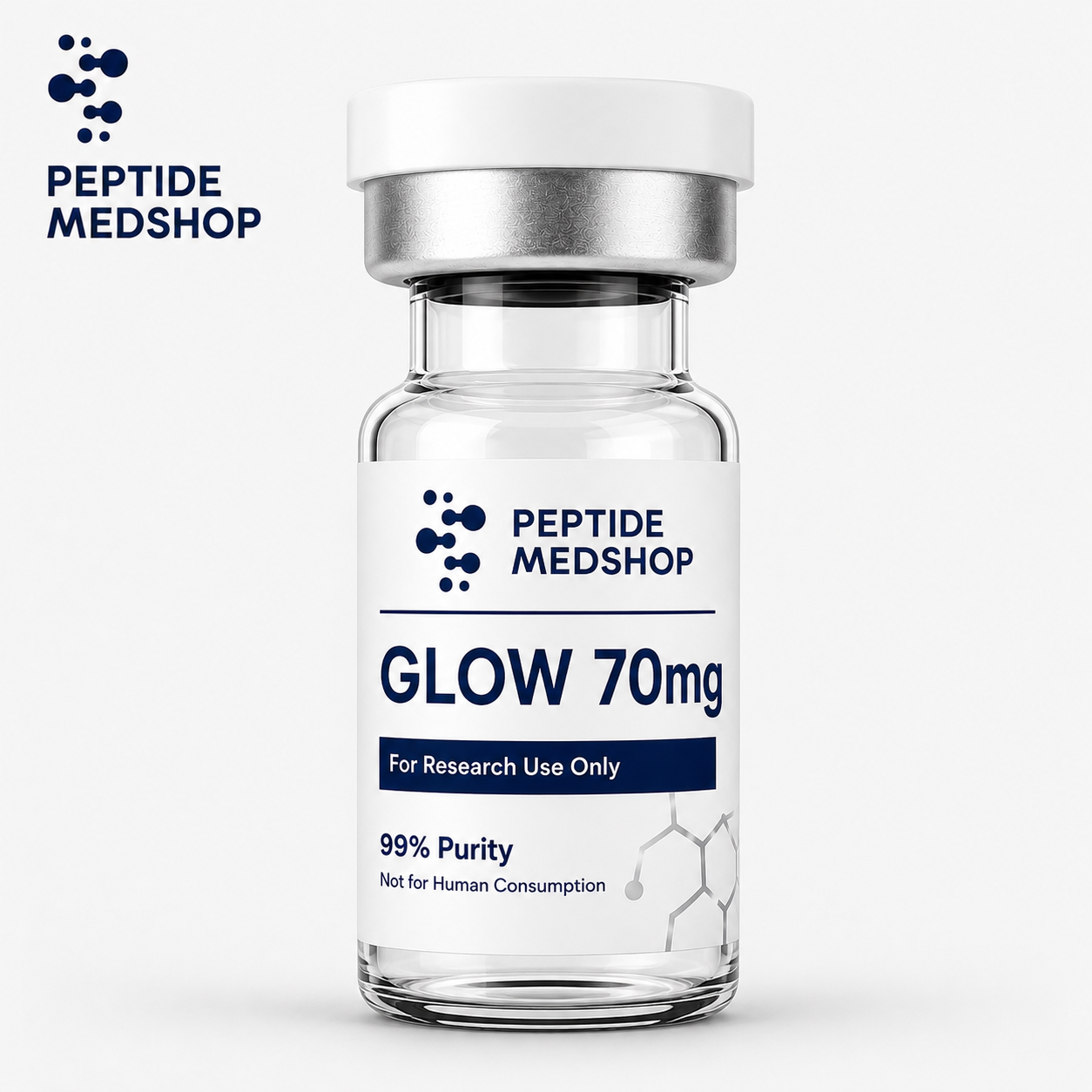
Buy GLOW 70mg Online
Buy GLOW 70mg Online is an investigational research peptide blend commonly formulated with GHK-Cu (Copper Tripeptide-1), BPC-157, and TB-500. It has gained attention in laboratory research because it combines three compounds that are individually being investigated for their roles in cellular signalling, tissue biology, extracellular matrix research, and regenerative science.
Although the blend is widely discussed within research communities, GLOW 70mg is not approved by the U.S. Food and Drug Administration (FDA) for the treatment of any disease or medical condition. Current evidence is primarily derived from laboratory and animal studies involving the individual components, while direct research on the combined formulation remains limited.
For information about research products and laboratory supplies, visit:
Website: https://peptidemedshop.com/
WhatsApp: +1 (931) 305-2367
Telegram: @sourcesplug
What is GLOW 70mg?
GLOW 70mg is a research formulation that commonly contains:
- GHK-Cu – 50 mg
- BPC-157 – 10 mg
- TB-500 – 10 mg
These three investigational compounds are co-lyophilised into a single vial for laboratory research. Researchers study the blend because each component targets different biological pathways involved in cellular communication and tissue biology. Formulations may differ between manufacturers, so researchers verify composition before beginning experimental work.
How does GLOW 70 mg work?
Scientists continue investigating how the individual components influence biological processes.
Current laboratory research focuses on:
- Cellular signaling
- Extracellular matrix biology
- Copper-dependent biological pathways
- Tissue remodeling
- Angiogenesis research
- Cell migration
The combined formulation itself has not been extensively studied in humans, so its overall biological effects remain under investigation.
Key Components
GHK-Cu
GHK-Cu is a naturally occurring copper-binding tripeptide that has been investigated for its role in skin biology, collagen research, and cellular signalling.
BPC-157
BPC-157 is a synthetic peptide derived from a gastric protein fragment. Researchers study it in laboratory models involving tissue biology and gastrointestinal research.
TB-500
TB-500 is a synthetic peptide related to Thymosin Beta-4. It is investigated for its relationship to cell migration, angiogenesis, and tissue organisation in experimental systems.
Each ingredient contributes to a different area of scientific interest, making the blend a subject of ongoing laboratory investigation.
Current Areas of Scientific Research
Researchers continue exploring GLOW 70mg and its components in several fields.
Tissue Biology
Scientists investigate how these peptides interact with cellular repair pathways and extracellular matrix organisation.
Skin Research
GHK-Cu has generated interest because of its relationship with collagen biology and skin-related laboratory research.
Cellular Communication
Researchers examine signalling pathways that regulate cellular migration and tissue organisation.
Regenerative Biology
The combination is also studied in preclinical regenerative biology models to better understand interactions between different peptide pathways.
Why Researchers Study GLOW 70mg
Scientific interest continues because of the blend:
- Combines three widely studied investigational compounds
- Supports research into cellular signalling
- Provides insight into connective tissue biology
- Helps investigate extracellular matrix function
- Contributes to peptide pharmacology research
Researchers emphasise that encouraging laboratory findings should not be interpreted as evidence of proven clinical benefit.
Current Scientific Evidence
Published information regarding GLOW 70mg includes:
- Laboratory investigations
- Cell culture research
- Animal studies involving individual peptides
- Reviews of peptide pharmacology
Most available evidence relates to GHK-Cu, BPC-157, and TB-500 individually, rather than the combined formulation. High-quality human clinical trials evaluating the blend itself remain limited, and no FDA-approved therapeutic indication exists for GLOW 70mg.
Product Quality Matters
Reliable laboratory investigations depend on high-quality research materials.
Researchers generally look for:
- High-purity research compounds
- Independent quality testing
- Secure packaging
- Consistent manufacturing standards
- Reliable product documentation
Using quality-controlled materials helps support reproducible scientific research.
Storage Recommendations
To help preserve peptide stability:
- Store according to the manufacturer’s recommendations.
- Keep products in a cool, dry location.
- Protect from excessive heat and direct sunlight.
- Keep containers tightly sealed.
- Follow supplier guidance for laboratory handling and storage.
Proper storage helps maintain the quality of research materials.
Frequently Asked Questions
What is GLOW 70mg?
GLOW 70mg is an investigational peptide blend commonly formulate with GHK-Cu, BPC-157, and TB-500 for laboratory research purposes.
Is GLOW 70mg FDA approve?
No. GLOW 70mg is not approve by the U.S. FDA for treating any disease or medical condition and remains a research-use formulation.
Why do researchers study GLOW 70mg?
Researchers investigate the blend to better understand cellular signaling, extracellular matrix biology, connective tissue research, and regenerative mechanisms.
Is there human research?
Direct human research evaluating the combined GLOW 70mg formulation is limited. Most published evidence involves the individual components rather than the blend itself.
Why GLOW 70mg Continues to Receive Scientific Attention
Interest in GLOW 70mg remains strong because it combines three investigational compounds that are individually studied in several areas of biomedical science, including:
- Tissue biology
- Cellular signaling
- Skin research
- Extracellular matrix biology
- Regenerative science
- Peptide pharmacology
Future research may clarify how these compounds interact when studied together and whether additional biological insights emerge from combination research.
About Peptide Med Shop
Peptide Med Shop provides research products and laboratory supplies for scientific and educational purposes.
For more information:
Website: https://peptidemedshop.com/
WhatsApp: +1 (931) 305-2367
Telegram: @sourcesplug
Final Thoughts
GLOW 70mg is an investigational peptide blend that combines GHK-Cu, BPC-157, and TB-500 into a single research formulation. While each component has generate scientific interest in laboratory studies, the blend itself has not been establish as safe or effective for treating any medical condition, and it is not FDA-approve. Continued laboratory and clinical research will be necessary to better understand its biological mechanisms, safety profile, and potential future scientific applications.
Be the first to review “Buy GLOW 70mg Online”
Related products
Lyophilized
Lyophilized
Lyophilized
Lyophilized
Lyophilized
Lyophilized
Lyophilized
Lyophilized
Reviews
There are no reviews yet.