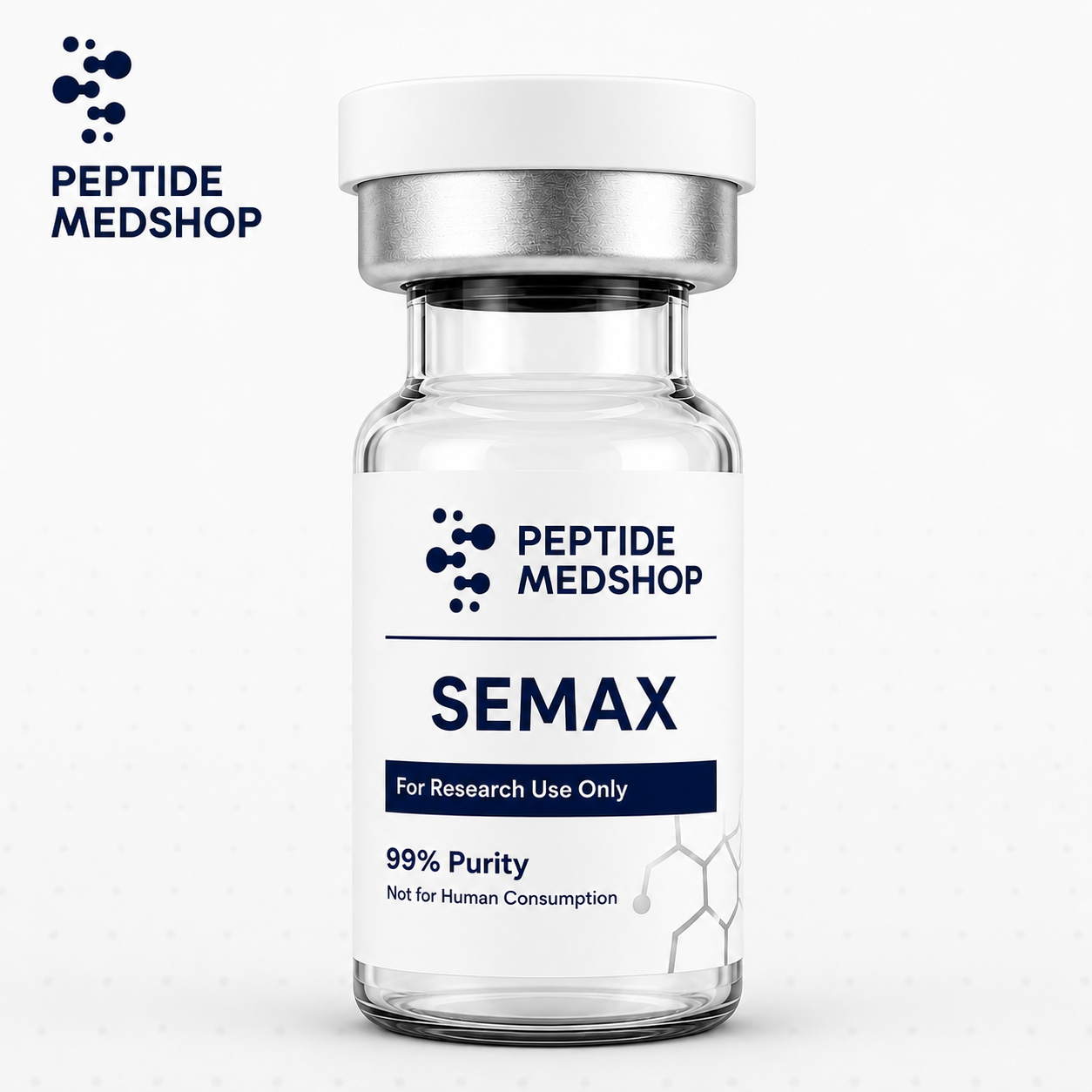
Buy Semax Online
Buy Semax Online is a synthetic heptapeptide originally developed in Russia from a fragment of adrenocorticotropic hormone (ACTH 4–10). It has attracted considerable scientific interest because of its potential role in neuroscience, cognitive research, neuroprotection, and stress-response biology. For more than three decades, researchers have investigated Semax in laboratory studies and clinical settings, particularly in Russia and Eastern Europe.
Although Semax has been approved for certain neurological indications in Russia, it is not approved by the U.S. Food and Drug Administration (FDA). Outside Russia, Semax is generally considered an investigational peptide, and additional high-quality international clinical trials are needed to better establish its safety and effectiveness.
For information about research products and laboratory supplies, visit:
Website: https://peptidemedshop.com/
What Is Semax?
Semax is a laboratory-developed peptide consisting of seven amino acids. It was engineered by modifying a naturally occurring fragment of ACTH and adding a Pro-Gly-Pro sequence to improve stability.
Unlike ACTH itself, Semax does not appear to have significant hormonal activity. Instead, researchers study it primarily for its potential effects on brain signalling, learning, memory, and neuroprotection.
Because of these characteristics, Semax has become one of the best-known neuropeptides in cognitive neuroscience research.
How Does Semax Work?
Scientists continue investigating the biological mechanisms responsible for Semax activity.
Current research suggests it may influence several important neurological pathways, including:
- Brain-derived neurotrophic factor (BDNF)
- Nerve growth factor (NGF)
- Dopamine signaling
- Serotonin regulation
- Neuroplasticity
- Cellular stress responses
Researchers believe these pathways may help explain why Semax continues to be studied in cognitive and neurological research, although additional human studies are still needed to confirm many proposed mechanisms.
Current Areas of Scientific Research
Cognitive Neuroscience
Semax is widely investigated for its possible influence on attention, learning, memory, and cognitive performance in experimental settings.
Neuroprotection
Laboratory studies continue exploring whether Semax affects biological pathways involved in neuronal survival and recovery following neurological injury.
Stroke Research
Clinical research conducted primarily in Russia has evaluated Semax as part of treatment strategies for ischemic stroke. While these studies are of scientific interest, broader international evidence remains limited.
Stress Biology
Scientists also investigate how Semax interacts with stress-response pathways and neuroendocrine signaling.
Brain Plasticity
Researchers continue studying Semax because of its reported effects on molecules associated with neuronal growth and communication.
Why Researchers Study Semax
Semax remains an important subject of peptide research because it:
- Is derived from an ACTH fragment
- Has more human research than many experimental peptides
- Has been used clinically in Russia for decades
- Is investigated for its neuroprotective and cognitive mechanisms
- Continues to generate interest in neuroscience and peptide biology
Researchers emphasise that most published clinical evidence originates from Russia and Eastern Europe, highlighting the need for additional independent international trials.
Current Scientific Evidence
Research involving Semax includes:
- Laboratory studies
- Animal experiments
- Human clinical investigations
- Stroke research
- Cognitive neuroscience studies
- Neurobiology research
Although several published studies have reported encouraging findings, the overall evidence base remains insufficient for broad regulatory approval in many countries. Larger, well-controlled clinical trials are needed to confirm efficacy and long-term safety.
Product Quality Matters
Reliable laboratory research depends on high-quality materials.
Researchers generally look for:
- High-purity research compounds
- Secure packaging
- Reliable manufacturing standards
- Consistent product quality
- Professional customer support
Quality-controlled materials contribute to reproducible laboratory investigations.
Storage Recommendations
To help preserve peptide stability:
- Store according to the manufacturer’s recommendations.
- Keep products in a cool, dry place.
- Protect from excessive heat and direct sunlight.
- Keep containers tightly sealed.
- Follow supplier guidance for laboratory storage and handling.
Proper storage helps maintain product integrity during research.
Frequently Asked Questions
What is Semax?
Semax is a synthetic heptapeptide derived from an ACTH fragment that has been studied in neuroscience, cognition, neuroprotection, and stress-response research.
Is Semax FDA-approved?
No. Semax is not approved by the U.S. FDA. It has been used clinically in Russia, but remains investigational in the United States.
Why do researchers study Semax?
Scientists investigate Semax because of its potential interactions with neurotrophic factors, neurotransmitter systems, and mechanisms involved in learning, memory, and neuronal function.
Is there human research?
Yes. Human studies have been conduct, particularly in Russia, including research involving neurological conditions. However, broader international evidence remains limited and further clinical trials are need.
Why Semax Continues to Receive Scientific Attention
Semax continues to be one of the most widely discuss neuropeptides because it combines decades of laboratory research with clinical experience in certain countries.
Researchers continue exploring:
- Brain plasticity
- Cognitive neuroscience
- Neuroprotection
- Stress adaptation
- Neurotransmitter regulation
- Peptide pharmacology
As scientific understanding advances, future research may better define the role of Semax in neurological science and determine where it may have clinically meaningful applications.
About Peptide Med Shop
Peptide Med Shop provides research products and laboratory supplies for scientific and educational purposes.
For more information:
Website: https://peptidemedshop.com/
WhatsApp: +1 (931) 305-2367
Telegram: @sourcesplug
Final Thoughts
Semax remains one of the most extensively studied neuropeptides in cognitive and neurological research. Its potential interactions with neurotrophic factors, neurotransmitter systems, and brain plasticity have made it a significant topic in neuroscience. Although Semax has been use clinically in Russia for certain neurological conditions, it is not FDA-approve in the United States, and much of the publish evidence comes from a limit number of regions. Continue high-quality international research will be essential to better understand its mechanisms, safety profile, and potential future clinical applications.
| Choose Options | 5mg* 10Vials, 10mg*10Vials |
|---|
Be the first to review “Buy Semax Online”
Related products
Lyophilized
Lyophilized
Lyophilized
Lyophilized
Lyophilized
Lyophilized
Lyophilized
Lyophilized
Reviews
There are no reviews yet.