
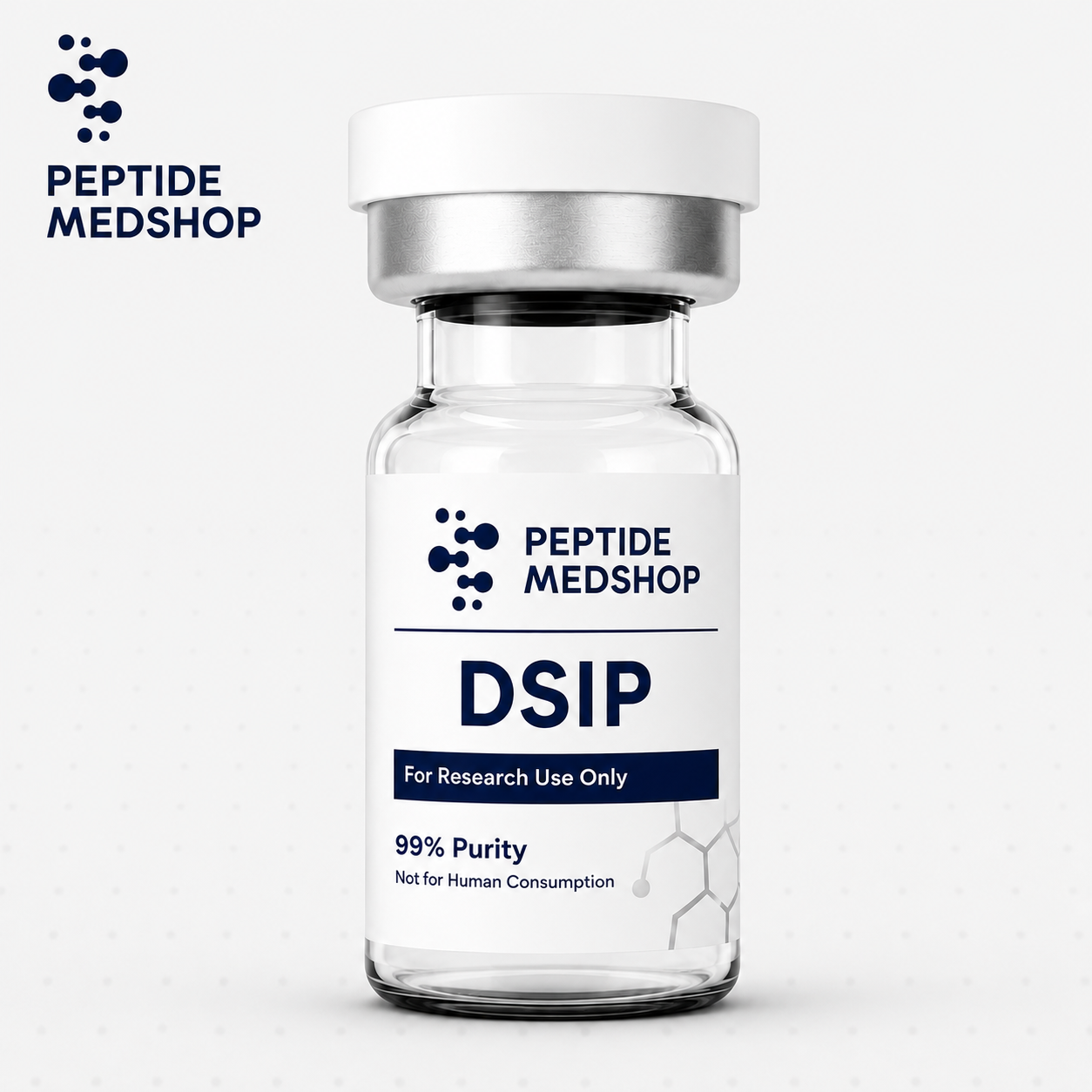
Buy DSIP Online
Buy DSIP Online. Delta Sleep-Inducing Peptide (DSIP) is a naturally occurring nonapeptide consisting of nine amino acids that has been studied for several decades in neuroscience and sleep research. First identified in the 1970s, DSIP attracted scientific interest because early animal experiments suggested it might influence delta-wave sleep. Since then, researchers have explored its possible roles in sleep regulation, stress biology, neuroendocrine function, and pain modulation.
Although DSIP remains an interesting research compound, its biological role is still not fully understood. Human studies have been limited, often small, and have produced mixed findings. At present, DSIP is not approved by the U.S. Food and Drug Administration (FDA) or other major regulatory agencies for treating any medical condition, and it should be regarded as an investigational research peptide. Current evidence does not establish DSIP as an effective treatment for sleep disorders or other health conditions.
For information about research products and laboratory supplies, visit:
Website: https://peptidemedshop.com/
What Is DSIP?
DSIP is a naturally occurring peptide composed of nine amino acids. It was originally isolated from the cerebral venous blood of rabbits during experiments involving electrically induced sleep. Researchers named the compound “Delta Sleep-Inducing Peptide” because of its initial association with delta-wave sleep activity in animal models.
Over time, scientists discovered that the biology of DSIP is considerably more complex than originally believed. Its exact receptor has not been definitively identified, and its physiological role remains an active area of investigation. Researchers continue to study DSIP as a laboratory tool for understanding sleep regulation and neuroendocrine signalling.
How Does DSIP Work?
The precise mechanism of action of DSIP remains uncertain.
Current research suggests it may influence several biological systems, including:
- Sleep architecture
- Neuroendocrine regulation
- Stress-response pathways
- Hypothalamic signaling
- Cortisol regulation
- Neurotransmitter activity
Researchers have proposed that DSIP may interact indirectly with GABAergic, glutamatergic, and opioid signalling pathways, although these mechanisms have not been fully established. Additional laboratory and clinical studies are needed to better understand how the peptide functions.
Current Areas of Scientific Research
Scientists continue investigating DSIP in several areas of biomedical science.
Sleep Research
DSIP is most commonly studied because of its historical association with sleep regulation. However, modern research indicates that its effects on human sleep remain inconsistent and require further investigation.
Stress Biology
Researchers are exploring whether DSIP influences the body’s stress-response systems, including interactions with the hypothalamic-pituitary-adrenal (HPA) axis.
Neuroendocrinology
Laboratory studies continue to examine how DSIP may affect hormone regulation and communication between the nervous and endocrine systems.
Neuroscience
Scientists also investigate DSIP in relation to neuronal signalling, neuroprotection, and brain physiology.
Why Researchers Study DSIP
DSIP remains scientifically interesting because it:
- Is one of the earliest neuropeptides investigated in sleep research
- Has decades of laboratory research
- May interact with multiple physiological systems
- Continues to generate interest in neuroendocrinology
- Provides insight into sleep-related biological pathways
Although many hypotheses have been proposed, researchers emphasise that substantial uncertainties remain regarding its biological significance.
Current Scientific Evidence
Published research involving DSIP includes:
- Laboratory experiments
- Animal studies
- Small human clinical investigations
- Neuroendocrine research
- Sleep physiology studies
Despite decades of investigation, the evidence remains mixed. Human studies have generally been limited in size and have not consistently demonstrated clinically meaningful effects. Consequently, DSIP is still considered an investigational compound rather than an established therapeutic agent.
Product Quality Matters
Reliable laboratory research depends on high-quality materials.
Researchers generally seek:
- High-purity research compounds
- Secure packaging
- Reliable manufacturing practices
- Consistent product quality
- Professional customer support
Using quality-controlled materials helps support reproducible scientific investigations.
Storage Recommendations
To help preserve peptide stability:
- Store according to the manufacturer’s recommendations.
- Keep products in a cool, dry location.
- Protect from excessive heat and moisture.
- Keep containers tightly sealed until laboratory use.
- Follow supplier instructions for handling and storage.
Proper storage supports product integrity during research.
Frequently Asked Questions
What is DSIP?
DSIP (Delta Sleep-Inducing Peptide) is a naturally occurring nine-amino-acid peptide studied primarily in sleep physiology, stress biology, and neuroendocrinology research.
Is DSIP FDA-approved?
No. DSIP is not approved by the U.S. FDA or other major regulatory authorities for treating any disease or medical condition.
Does DSIP improve sleep?
Although early research suggested a possible relationship with delta-wave sleep, human evidence has been inconsistent. Current scientific evidence is insufficient to conclude that DSIP is an effective treatment for sleep disorders.
Why do researchers continue studying DSIP?
Researchers continue investigating DSIP because it may provide valuable insights into sleep regulation, stress physiology, and neuroendocrine signalling, even though its exact biological role remains uncertain.
Why DSIP Continues to Receive Scientific Attention
Interest in DSIP continues because it represents one of the earliest peptides associated with sleep research.
Current scientific investigations focus on:
- Sleep physiology
- Stress adaptation
- Neuroendocrine communication
- Brain signaling
- Peptide biology
- Circadian regulation
Future research may clarify whether DSIP has a defined physiological role and whether any clinically relevant applications emerge.
About Peptide Med Shop
Peptide Med Shop provides research products and laboratory supplies for scientific and educational purposes.
For more information:
Website: https://peptidemedshop.com/
WhatsApp: +1 (931) 305-2367
Telegram: @sourcesplug
Final Thoughts
DSIP (Delta Sleep-Inducing Peptide) remains an intriguing subject of neuroscience and sleep research. While it has been investigated for nearly five decades, important questions about its mechanism of action, physiological role, and potential clinical relevance remain unanswered. Current evidence from human studies is limited and inconsistent, and no major regulatory agency has approved DSIP for medical use. Ongoing research will continue to improve scientific understanding of this unique neuropeptide and its place in modern peptide biology.
| Quantity | 5mg, 10 mg |
|---|
Be the first to review “Buy DSIP Online”
Related products
Lyophilized
Lyophilized
Lyophilized
Lyophilized
Lyophilized
Lyophilized
Lyophilized
Lyophilized
Reviews
There are no reviews yet.